Pickled Priest Cover Story #17: On the Syme Page: Rush's Album Covers Assessed and Ranked
Updated: Jan 27
The bond between Rush's membership triangle is legendary and well-documented. That bond extends to their peripheral partnerships, too. If you were allowed into their triangle of trust, you often stayed there. Which is why the band's resident Art Director, Hugh Syme, maintained such a long, collaborative relationship with the band. He was the main creative mind behind every Rush album cover with the exception of the first two and his work over the decades is as diverse as it is impressive. If you didn't know better, you'd assume many different art directors were involved over the years. He didn't favor any one style or approach and that's what made him such a valuable asset to the band. The story of Rush is best told through their music, of course, but it can also be told visually. That's where we come in. Pickled Priest ranks the band's album covers from worst to best, even adding a few choice live albums into the mix along the way. We are well aware Rush fans can be very protective of their heroes, but that won't stop us from calling out a shitty cover when we see one. Keep in mind this is one Rush fan's list.
Let the debate begin.
PICKLED PRIEST RANKS RUSH'S ALBUM COVERS
FROM WORST TO BEST
23 A Show of Hands (1989)
Grade: F

This is the kind of art you might find hanging over the toilet in the bathroom of a suburban beauty salon. It's also what you get when you try to combine Patrick Nagel's color palette with Pablo Picasso's Three Musicians into one painting. Not only that, but the album is titled A Show of Hands and none of the musicians pictured have actual hands. If that's supposed to be ironic, we've reached rock bottom on the irony meter. I guess it didn't really matter in the end, for this was the band's third live album, coming off three fair albums in a row, and most people with a passing interest in the band had checked out of the Hotel Rush by this point. Only die-hards remained and a cheap, quickly executed album cover wasn't going to stop them from enjoying live versions of their favorite late-period Rush songs like "Red Sector A," "The Rhythm Method," or "The Big Money." Personally, I forgot this record even existed until recently.


22 Test for Echo (1996)
Grade: D-

I admit, I've never even heard this album before and even this project hasn't been a catalyst to do so. If this cover could talk, and thank god it can't, it would likely bellow, "I'm inessential" under its breath, nowhere near loud enough to generate an echo effect (and there's no need to even test that theory). No wonder I took a hard pass at the time of release. It has the feel of a later-period album cover where budget and creative motivation are both lagging. It's no coincidence that the best album covers often come from the best albums. When the artist raises their game, everybody else tends to follow suit. Surprisingly, a lot of work went into this cover's development, with Hugh Syme working overtime to build the cover model from a photo provided to him by Neil. After he did that, he used baking soda to simulate the snow and then snapped a photo. I'd think this the result of an early AI test query if it wasn't actually created in 1996. Even worse, if you look closely, you'll see the band climbing the structure, a weird Honey I Shrunk the Members of Rush effect that makes the whole well-intentioned cover seem like a goofy Disney movie set in the Yukon.
21 Presto (1989)
Grade: D

If Hugh Syme had one fault, it would be his tendency to go for the easy out with some of his cover designs. Sometimes he would resort to an easy pun and call it a day (as we will see later and with varying levels of success). The band, also possessors of a goofy sense of humor, didn't stop him, either. No wonder they worked with him for so long. This cover tells me he went with the first image that popped into his mind when the band laid the new album title on him. Let's face it, going with a bunch of rabbits crawling out of a magician's top hat for an album titled Presto doesn't require a high-priced designer to develop the concept. A seven-year-old girl could've come up with the idea. The hardest part was corralling the rabbits for the photo shoot, a process so challenging that some of them were eventually provided by a taxidermist. If the main draw of the cover is figuring out which rabbits are real and which ones are stuffed, you know you've got a problem.
20 Different Stages (1998)
Grade: D+

Not a horrible idea for a cover and I do appreciate the simplicity of it, but does it really excite anyone who looks at it? Definitely not. You know they probably wanted a Red Ryder Carbine Action 200-shot Range Model Air Rifle with a compass in the stock for this cover, but settled for these tinker toys instead. And settling will never get you what you really want, will it? Unless, of course, what you really desire is a rare live version of "Cygnus X-1." Then, this three-disc monster live album would've made you one happy camper on Christmas morning.
19 All the World's a Stage (1976)
Grade: C-

There's a certain historical charm to this pre-show photo of Rush's mid-70s stage setup, particularly the relative minimalism of Neil's kit, but other than that, it is pretty unimaginative, even if it complements the album's title. It all makes sense, and it's safe, which could be its biggest drawback. Grade taken down from a C to a C- for adding the chunky border, which does the cover no favors.
18 Snakes & Arrows (2007)
Grade: C-

The colors emit a distinct New Orleans vibe, but Ontario is pretty far from the Deep South. It's not a terrible image, one that might hang above the potion shoppe of a voodoo priestess, but it's too washed out to make any visual impact at all. That's too bad, because I can see how this might have worked with proper execution. Instead, it looks like they got the patient from Operation to sit criss-cross-applesauce in a snake pit. An obi strip simulation on the right attempted to modernize things, but by this point a cool font ain't gonna save the day all by itself. How can something be colorful and bland at one time? Here's your answer.

17 Clockwork Angels (2012)
Grade: C

I want to like this, I really do, but somehow it seems a bit lazy to me. It looks like a hurricane making landfall in hell (hell-bent, if you will). Not a bad concept, in theory. But anyone could take an overhead picture of a hurricane and add a red tint to it with a few clicks on their iPhone. There's not much to it until you overlay an ancient clock with symbols in place of numbers (each pertaining to a specific song). I think you can buy this same clock right now on Wayfair for about 30-bucks. Very Zeppelin, isn't it? A touch of the occult, perhaps, which adds a bit of mystery to a pretty generic image. In my opinion, Clockwork turned out to be one of Rush's best later-era albums, but the cover is nothing special. As is, just zo-so.
16 Vapor Trails (2002)
Grade: C+

The story behind Vapor Trails is well-known to Rush fans. It was the band's first album in five-years after Neil Peart took a hiatus to deal with the tragic loss of both his daughter and life-partner over a twelve-month period. In fact, there was no guarantee he would ever come back. Whatever it took to deal with it, he did, including, famously, 55,000 miles of road on his motorcycle. When it finally came time to record a new album, and subsequently design the cover, he recounted to Syme a comet he had witnessed blazing across the evening sky. It seemed to encapsulate everything Peart was writing about for the album. After some discussion, Syme did a quick mock-up to ensure he understood Peart's vision. Neil loved it so much he went with that initial rough draft for the cover (against Syme's wishes, of course). It's a pretty cool story. On its own, is the cover as striking and powerful as intended for the average fan? Not really. I guess it's reasonably cool, but I'm neither drawn to it or away from it. In the end, if it worked for Neil, it works for us.
15 Caress of Steel (1975)
Grade: C+

I've never loved this album title, but that's beside the point. What I have always been fascinated by is the blisteringly hot inner workings of a steel foundry, a process that hearkens back to a more primitive time in our industrial history and still remains active to this day. Here, the gold letters seem to be freshly poured, slowly hardening into their final form. Very cool and very hot simultaneously. The interior image is a little less successful. I'm picking up an ancient sorcerer vibe that fits the kind of lyrics Peart was writing at the time (no silly love songs from Neil unless a song titled "The Necromancer" falls into your definition), but it's incongruous with the lettering. The image would just look much better if, like the lettering, it looked like liquid gold. Instead, it almost seems like we are looking into a crystal ball or something. Not a major beef, but Syme's first cover for Rush left a lot to be desired.

14 Signals (1982)
Grade: B-

A pretty controversial cover that the record label hated, but I love when a record label gets its shorts in a bunch, so kudos for that reaction. Moving Pictures to Signals was as a huge deviation in sonics and visuals and that's to the band's credit. This album, in many ways, is kind of the prog version of Springsteen's The River segueing into Nebraska. A follow up to a big hit with something completely different and far less marketable. Not what anyone at their label truly wanted or needed at the time. It all turned out alright in the end, of course, and was another victory for art over commerce. To this day, no cover in the Rush catalog divides people like this one. A Dalmatian sniffing a fire hydrant while standing on artificial turf? I get the suburbia tie-in to "Subdivisions," so I guess it's a radical rethinking of every aspect of the band's image and should be rewarded. A ballsy move, but I still don't love it like some do. I might've ditched the thick, tan border and ink-pen font, but credit where credit is due. Syme and band really shook things up with this approach. Art critics, to this day, cite it as one of their favorite album covers in any genre, so what do I know?
13 Hold Your Fire (1987)
Grade: B-

It doesn't take a genius to get the concept here (power trio = three balls). I appreciate the minimalist approach. I also like the embossed band name and tiny title. Very subtle. Same with the floating balls effect achieved through shadowing. Red coloring...nice. Rush's default color of choice. Interior images reveal a more complex side of this artwork, but we're not assessing anything but covers today. It is worth looking into if you haven't already. Syme won't get the Nobel Prize for Album Covers with this one, but it still works pretty well.
12 Roll the Bones (1991)
Grade: B-

A cool idea, but a little overworked. Here's the point-by-point breakdown. Wall of dice: A highlight. I like it every day and I've never seen it done before. Lowercase band name: I would've gone with capital letters, but not a big problem. Placement of album title: Excellent. I like that they put it in the underline. Kid walking down the sidewalk: Over-posed. Kid kicking skull: Questionable—for a small foot to elevate a skull that large he'd be in substantial pain after booting it that far up and out. so it's a bit hard to swallow. It's not an aluminum soda can or something. Sidewalk: OK, no issue. Sidewalk next to a body of water? Doesn't seem realistic. Plus, one wrong kick and the skull game is over. In other words, this cover seems to be trying way too hard despite a few stellar design ideas.
11 2112 (1976)
Grade: B

The cover art for an iconic album will almost always stir the hearts and passions of true fans. That's understandable. If we love the music, the artwork associated with that music takes on a disproportionate level of importance, sometimes overshadowing the fact that it isn't a very good album cover at all when take on its own merits. Which is why, when assessing album art, you have to distance yourself from the musical experience and focus primarily on the visual experience. Rush's 2112 isn't a bad cover. What I see when I look at the cover is Rush's name in North Carolina blue and a serif-heavy font you might see on a box of detergent at the supermarket. Try new and improved Rush Detergent! It'll blast your toughest stains into the Solar Federation! The year 2112, with similar font, only darker blue (borderline purple) with a pinkish hue outline, doesn't do the cover any favors. A starry sky illuminates the night, beaming down upon the star/circle logo that has become synonymous with Rush ever since, very similar in concept to the band's "Starman" logo. It's pretty cool when a band is known by a symbol or symbols and not their own name. Now that's branding! The black background works, too, adding a creepy sense of mystery to the whole thing. I guess I won't know what could've been here until I see it, but something tells me this cover could've been much more impactful without losing its ominous overtones.
10 Exit...Stage Left (1981)
Grade: B+
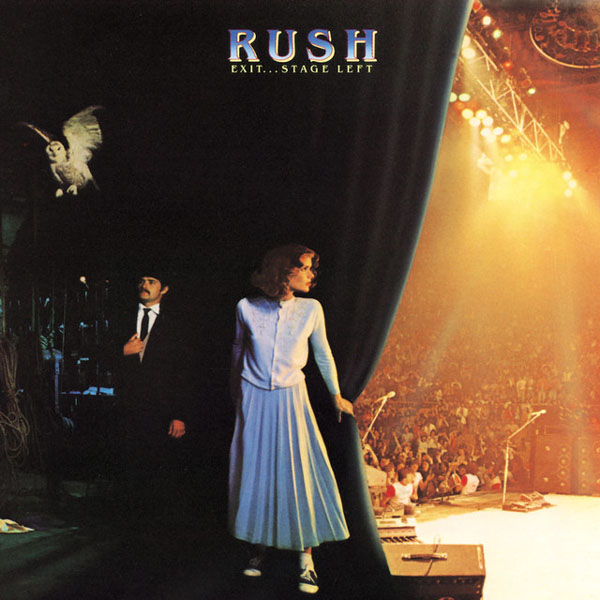
I guess this cover of Rush's second live album, Exit...Stage Left, is a bit of a spoiler in that it contains elements of all of Rush's past albums to this point in their now booming career. Every album, if you include the gatefold (which we don't normally do when we assess covers—we only assess what someone would see when flipping through a record rack), has one reprised image from each of their studio albums. It's a pretty good idea, especially because the band is soon to take the stage with their entire body of work about to be represented on the set list (sans their debut and Caress of Steel). Pretty clever and well presented. But I won't comment any more on the individual components since we have ten more albums to discuss.

09 Counterparts (1993)
Grade: B+

Considering Rush’s deserved reputation for being a “high concept” band this lean toward simplicity is a refreshing change of pace for Syme. It can’t get much less complex and technical than this instruction manual-styled diagram of the functionality of a nut and a bolt. This makes an Ikea diagram look like a walk in the park. The image also makes you think of other things that have a dependent relationship. If you must draw sexual innuendo from the cover, that’s your right, but it wasn’t intended at the time. I do appreciate the dotted line that guides the bolt through the nut, as if you couldn’t figure out how do it on your own. Never assume intelligence, I guess. In all ways, the Counterparts cover is the anti-Rush album cover. It’s nothing like anything they’d done before. The dark blue background and the “photo negative” nut and bolt diagram is visually appealing, more than you’d expect from such a stripped-down design concept. Adding the band name in an understated lowercase font complements the assembly instruction visual, making this cover an unexpected standout in a portfolio full of fantastical imagery.
08 Hemispheres (1978)
Grade: B+

Deep. Very deep. This is what happens when you spend a lot of time sipping top-shelf cognac with Neil Peart over a transatlantic phone line. This cover gets a lot of love from Rush fans and that's no surprise--they are predisposed to the philosophical and surreal worlds for which the band is known. That's a big part of the draw. Here, a besuited proper gentleman, inspired by the René Magritte painting, The Son of Man, stumbles upon a statuesque nude male, a la Michelangelo's David, on top of a giant exposed brain. What happens next is anybody's guess. The image does seem to be the perfect complement to the album's high concept lyricism and complex musicianship. Anything less could be mocked out of contempt for the ambition. The meeting on the mind is an indelible image, but I am not 100% in love with the bright blue background chosen. Is it just too much blue for its own good, I posit? Also, "David" and the brain seem to be of similar coloring causing a washout effect on the image. Perhaps that was intentional. I'll have to phone Hugh to find out. Overall, this cover has grand ambitions, but falls just short of achieving what it set out to do. As is, it is still very effective, but what could've been?

07 Rush (1974)
Grade: B+

If you didn’t know the band at all, you'd likely guess this was their debut album. No title, plus it uses a limited color palette, a sure indicator of a severely constrained design budget—very punk rock. Three colors and out. That's all we have money for, sorry boys. For a debut, having the band name emerging from an explosion was a genius idea, giving the impression something powerful is emerging from within its cardboard sleeve. Plus, it's rendered in a way that recalls a comic book panel. And who doesn't like a comic book hero with a good origin story? This album takes on that task for the band and so does its cover. Overall, pretty basic stuff as long as you can find an artist and a silkscreener to work on the cheap. No photographer, no photo shoot, no high-priced design firm. In fact, this is one of two covers in the band’s discography not designed by Hugh Syme. Instead, this one was developed by Paul Weldon, a Canadian musician and designer who would go on to do other album covers, most notably Funkadelic’s America Eats Its Young. He’s said he liked the idea because Rush was a trio that brought serious power behind their music. Hence, the explosion idea. In my mind, this is a perfect opening for a young promising band. To this day, the Rush lettering on their debut is favored by die-hard fans, and along with the Starman logo, has become its most recognizable brand symbol. The fact it has lasted so long is a testament to its visual appeal.
Side Note: The artwork on the original cover was more purplish in nature, but was changed to red later. Which one do you like better? I’m going with the purple, mainly because red is almost too predictable.
06 Fly By Night (1975)
Grade: B+

Neil Peart, in his first appearance on a Rush record, came up with this cover idea based on his recently-penned title song and it’s one of the more literal and straightforward designs in the Rush catalog. The owl, a natural choice to represent the nocturnal title, has an almost spiritual presence, much like Peart himself. I suppose a bat could’ve been used instead, but I think Rush is more of an owl band than a bat band, don’t you? A thinking man's outfit. This wise owl, with his piercing yellow eyes standing out against early onset darkness, makes it hard to turn away from his stare. You feel compelled to gaze at it until it moves, much like you would with an sitting on a branch in your backyard. Never have I seen an owl without wondering, at least for a while, if it was real or not. They have a stoic, unnerving presence, and those qualities are gorgeously captured by painter Eraldo Carugati (who famously painted the four Kiss solo album covers years later!) based on a general description provided by Peart. The image is quasi-realistic, containing elements of caricature (making it a giant owl being the most notable—just check out the trees next to him). It may not be the most imaginative cover, but it is certainly an effective reflection of the music within the album. The lettering, with some 3D shading, looks like it's flying as well. A subtle, but appreciated touch.
05 Grace Under Pressure (1984)
Grade: A-

I am really attracted to this striking cover and it is mainly due to its whitewashed composition, which makes it stand out from anything else Syme had produced for Rush to date. Before that, his covers had leaned to the darker side of the spectrum. With the title in mind, Syme went for something more minimalist in nature for this painting. He has said he was inspired by the covers of Keith Jarrett and U2's No Line on the Horizon, and those references make complete sense upon examination (see below). Here, white (or cream, to be specific) is the color of grace. The dark grey clouds that loom over the relatively calm waters bring with it a pressure system that will soon wreak havoc on its surroundings. The entire surreal design has a futuristic feel, almost like we're experiencing the climate of another planet. Is that an alien resident monitoring this unfolding stormfront? We'll never know for sure. There are some cool details to fawn over, as well: the water bleeding over the bottom edge, almost Dali-esque in its whimsy. Light touches of red add a mysterious aura to the painting as well. What is the symbolism here? Is it some kind of lava or blood? On another note, the font is perfect for a prog album and the band name in red sets it off just so. And, one last thing: Does anybody see a creepy eye peeking out of the mountainside or am I seeing things? Either way, a rare combination of the beautiful and the creepy. I love it.
Bonus Design Note: The P/G fraction to the middle right was added by Syme to reinforce his idea of the duality of the landscape (water/sky) and who am I to argue with him. Why not add a little piece of cryptic imagery while you have the chance?


04 Moving Pictures (1981)
Grade: A-

Even if you put no further thought into it, this cover would be a strangely captivating visual. But what exactly is happening? If you consider the title, then things come into focus, albeit in a whimsical and cheeky kind of way. Hugh Syme had a bit of a sense of humor and we all know the boys in Rush had a pretty goofy outlook on life as well, particularly Alex, so Hugh's tendency for a visual pun isn’t entirely out of character for the band. In fact, they probably reinforced his approach. The title Moving Pictures is famously represented in several ways on the cover:
Pictures (paintings) are being moved out of a museum (I presume).
A moving company is responsible for transporting the pictures elsewhere.
The pictures being removed from the museum are causing several bystanders to be moved to tears (because they are being taken from their local museum or because they love the art, we don't right know).
The picture in the first frame, the Joan of Arc image to be specific, is visually moving.
The moving pictures and those being moved by the moving pictures are being captured by a crew filming a moving picture (movie crew can only be seen on the back cover).
While you could legitimately accuse Rush and Syme of trying way too hard in service to a visual whim, the fact the cover still works despite this prevents them from losing their artistic license. The entirety of the visual just has a strange appeal, which isn't hurt by the dense black border and heavy blood red presence throughout. As we will see, this is not the only time Syme trotted out this approach to a cover. Guy loved to balance on the fence between fantasy and absurdity.
03 Power Windows (1985)
Grade: A

This cover painting by Hugh Syme originally featured the boy sitting in front of the window with a remote control and nothing else. The room was pretty much completely empty. That would've worked for me. I like a simple, powerful design. The antique TVs were included at Geddy’s insistence and their presence ended up adding further intrigue to the composition. The boy's remote won't work on the TVs, which are too old for such an innovation, so why then does he have one? Naturally, the kid assumes it must work on something. He tries the window. No luck. Perhaps the remote controls the weather outside? Will the push of a button send a lightning bolt down from the sky? There's only one way to find out. That's why I like the cover so much. That, and the intricate execution of the painting's fine details. The shadows throughout (his leg showing through his pajama bottoms is particularly well done), the grain of the hardwood floor, the period detail in the TV sets, the light from the bolt outside illuminating his face, etc. It's mildly unnerving that the boy is looking straight out form the cover as if looking for my guidance somehow. Am I doing this right? Why isn't it working? What's it for? Did I just cause that to happen? It's eerily haunting in a Twilight Zone-esque way. Also not lost on me is the band's name and album title, which complement the image with understated coloring, particularly the violet hue on his face that matches the shading on the letters (and the underline of the band name). Brilliant execution all around, Hugh!
02 Permanent Waves (1980)
Grade: A

If the design didn’t turn out so well, I’d be inclined to slap Mr. Syme around a bit for taking the easy route once again for this cover (as we discussed, he did the same thing for Presto and Moving Pictures as well). He basically took the album title and then crammed the cover with visual puns centered around different types of waves: a tidal wave crashing, the wave of the woman's dress, the "permanent" waves in her hair, a man waving in the background, radio waves in the title, and political waves seen on the newspaper headline to the far left*. He did have the smarts to make his gags somewhat subtle so the cover still looks visually attractive and strangely cohesive, too. He even catered to the band’s predominantly young male audience by including a white triangle of the woman’s panties underneath her dress, which I can personally tell you worked well for me at the time (I was in my early teens, so please understand). I do like that the image is in black and white as well. It plays off the red radio waves of the title and the yellow shading behind the band's name. A very pleasing composition overall with plenty to look at while the record is perched on your lap.
*Dewey Defeats Truman from the Chicago Tribune, a famous mistaken headline. Although, the Tribune ended up not granting approval for use, so they blurred/changed it as a result. Buzzkills.
01 A Farewell to Kings (1977)
Grade: A

In America, where we have regularly seen "No Kings" protests on our streets, this cover is particularly poignant. We see a so-called king dethroned and demoralized, his crown on the ground, his "castle" destroyed. If you look closer, however, you'll see that this king was actually a discarded puppet. The presence of lightly visible strings gives the impression the deposed king was nothing more than a marionette controlled all along by invisible forces with the means to do so, be that money or power and more likely, both. The dumb smile on the deposed king's face (actually a friend of photographer posing in the wreckage of a demolished Buffalo building) indicates he was but a toy and a fool, an unsustainable figurehead built on a fragile, weakening foundation frantically leaping from one issue to the next in fear of losing his much needed financial support. With an intact Toronto skyline behind him, his destruction looks both targeted and intentional, a calculated coup by a new, self-imposed leader. Is all this sounding strangely familiar to some of you? In all honesty, I can tell you the cover's eerie resemblance to modern politics and greed is not the main reason this cover made the #1 spot on our list. It's just a powerful image created by designer Hugh Syme to mirror the intent of the band's vision for the album, and particularly that of new drummer and lyricist, Neil Peart, who pens some real doozies throughout the album. Loosely, it's about invisible forces taking control of established worlds and let's leave it at that. That said, a quick review of the lyrics to the record's title-track might make you think this was recorded a few weeks ago, not almost a half century in our past. How's that for progress? Good grief.
To get his image just right, Hugh Syme blended several photographs into one image to best bring the cover to life. A beautiful blue sky sits behind the madness, but it is slowly being polluted by a smokestack emitting lord knows what into the atmosphere. There's a pleasing use of space as well, thanks to the perspective of the photographer. The placement of the band's name and album title in gothic lettering gives you the feeling this could be an ancient book from medieval times. The leatherbound throne only reinforces that idea. The black border holds the whole composition together, making the artwork look like it's already in a frame. The placement of the king is also wise. If they would've put him front and center, it would've looked contrived. This way, it looks like a quick snapshot taken by a journalist in the immediate aftermath of a detonated bomb. The king's controllers have gone, leaving him helpless to move within the crumbling structure behind him. I almost feel bad for this guy, elevated to such a high stature and then taken down without a moment's notice. I'm sure you've seen TV shows that start at the end and then flash back to the beginning to tell us the backstory ("Four Weeks Earlier..."). That seems to be what Rush is doing here. I'd love to know what preceded this dramatic moment. Start from the beginning, too, because I don't want to miss a thing. Or, you can just stare at the cover while the record plays and make up your own story. Either way works.
______________________
That's my opinion. How would you rank them?
Cheers,
The Priest